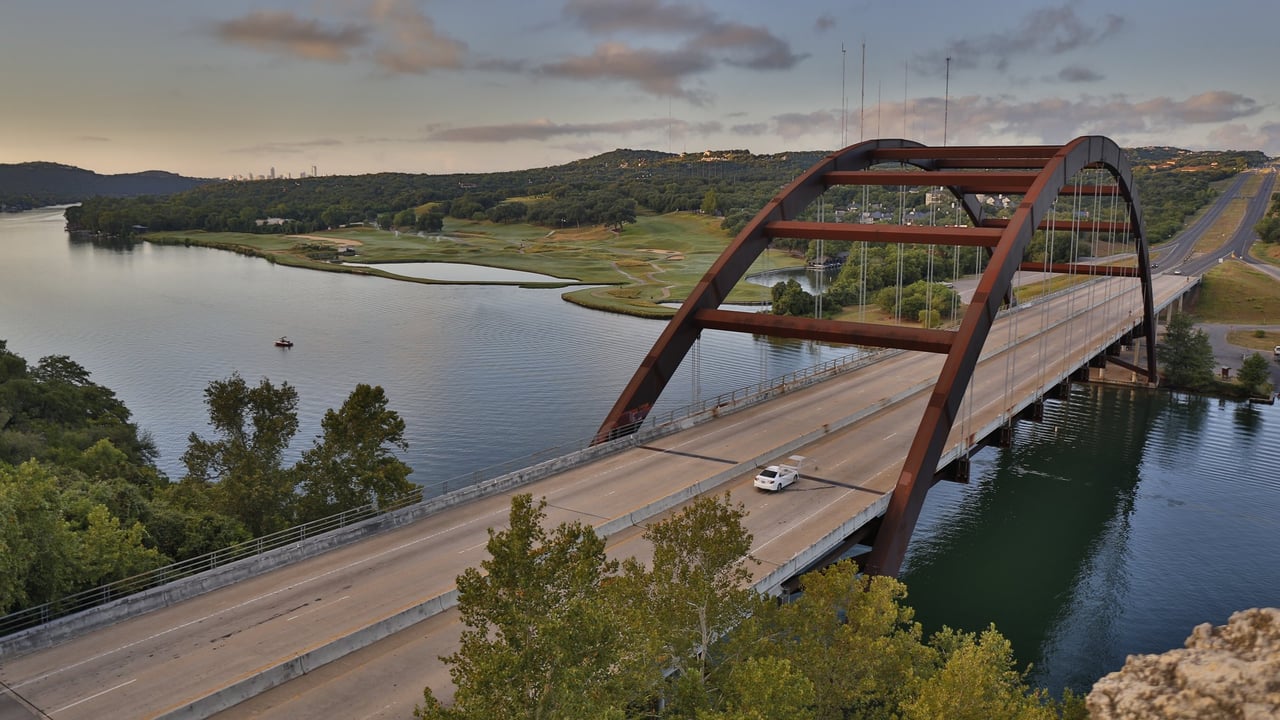
Daily life on Lake Austin in 2026 is built around the water: a private dock, a boat ride before the lake fills up on a weekend morning, and a shoreline that stays full year-round because Lake Austin is a constant-level reservoir held steady by releases from Lake Travis upstream. Lake Austin is not a single neighborhood. It is a waterfront corridor running through Westlake, Tarrytown, Rob Roy on the Lake, and the Highland Park bluffs, all west of Mopac. West Austin Realtor Brandon Galia works this market and knows what true frontage changes about a family's week.
Lake Austin at a Glance (2026)
- Constant-level lake: Lake Austin stays within a narrow band year-round, impounded by Tom Miller Dam (completed 1939) and held steady by releases from Lake Travis. Source: Lower Colorado River Authority.
- Size and setting: Roughly 1,600 acres, one of the seven Highland Lakes on the Colorado River, compared with Lake Travis at about 19,000 acres and fluctuating. Source: Texas Water Development Board / LCRA.
- Docks and rules: Docks and shoreline work on Lake Austin are permitted through the City of Austin, on different standards than LCRA's Highland Lakes docks, and the City enforces no-wake zones and designated ski areas with its own lake patrol. Source: City of Austin.
- Pricing (directional, professional analysis): True Lake Austin frontage generally starts around $2M and runs well past $10M for estate properties, with only a small number of genuine waterfront homes trading in a typical year. Figures are directional; Brandon can confirm current numbers against the MLS.
I live in Barton Hills with two daughters and a third on the way, so most of my weekends start with a car seat and a diaper bag, not a boat. But a few times a season I get my girls out on Lake Austin early, before the day starts, and it tells me more about this market than any listing sheet could. The water is glass at 7 a.m. A heron works the far bank. You can hear a paddle dip from a cove two hundred yards off. For about ninety minutes the lake belongs to the people who live on it.
Then it changes. By mid-morning on a warm Saturday the boat traffic thickens, the rowers give way to the ski boats, and the same water feels like a different lake. Residents plan around that rhythm. They go out early, come in by ten, and treat the busy middle of the day as someone else's turn.
That is the part most buyers never see. They tour a waterfront home at 2 p.m., fall for the view, and never learn what the morning is like. The morning is the product.
What is daily life on Lake Austin actually like?
Most people think living on Lake Austin is about the view. The families who love it most will tell you it is about the water, and the difference matters more than the price.
A view is passive. You look at it. The water is a routine: the boat you take out before coffee, the kids who learn to paddleboard off the dock before they can ride a bike, the cove you cruise up to on a Tuesday because you can. And because Lake Austin holds a constant level, that routine does not disappear in a dry summer. Docks stay usable and the boat does not end up on dry ground the way it can on a fluctuating reservoir.
That is the cleanest way to understand the two lakes side by side.
Lake Austin | Lake Travis | |
|---|---|---|
Water level | Constant year-round (LCRA) | Fluctuates with drought and rain |
Size | About 1,600 acres, narrow and winding | About 19,000 acres, open and wide |
Dock reality | Stays usable; drops only for scheduled maintenance drawdowns | Can leave docks on dry ground in a drought |
Boating feel | Calmer, no-wake stretches, rowing and paddle traffic | Open-water speed, big-boat lake culture |
Where it sits | Westlake, Tarrytown, Rob Roy on the Lake, Highland Park bluffs | Lakeway, Bee Cave area, farther west |
Neither is better. They are different buys for different families, and anyone who tells you Lake Austin and Lake Travis are the same lake has not spent a morning on both.
What do Lake Austin waterfront owners know that buyers don't?
You probably fell for a lake view from somebody's dock once and quietly filed the whole lake under one idea. Owning the shoreline is a different thing, and here is what the listing photos leave out.
First, not all waterfront is waterfront. There is true frontage, where your own dock sits on the water, and there is community water access, where a neighborhood shares a waterfront park or a boat ramp. Both are good. They are not the same purchase, and the gap between them runs into the millions. Steiner Ranch, for example, has a community waterfront park on Lake Austin, not private frontage.
Second, the lake is managed, not wild. The City of Austin permits docks and runs the no-wake and ski zones, and the LCRA periodically schedules a short drawdown so owners can repair docks and seawalls. Owners also watch hydrilla and lake-health issues closely, because the water quality is part of the asset. None of that is a problem. It is the maintenance layer that comes with the best part.
The best homes on Lake Austin rarely make it to the open market. I keep a short list of people who want to hear about them first. If that's you: join my off-market list
Who is Lake Austin waterfront right for, and who should skip it?
Buyers tell me: "We want to be on the lake."
Translation: some of them want the water, and some of them want the view and the story. Those are two different clients, and only one of them should pay the waterfront premium.
The family that belongs here will use the water on a Tuesday, not just in a July listing photo. If your week has a standing boat morning in it, if the kids will grow up swimming off the dock, the premium buys something you touch every day. The buyer who should skip it loves the idea of the lake but will use the dock four times a year. For that buyer, a view lot one street back, or a community with waterfront access, delivers most of the feeling for a fraction of the cost.
And the long timelines on the upper end are normal, not a warning sign. True waterfront is a small, selective pool, every property is unique, and the right home at the right number transacts on its own schedule.
Key Facts About Living on Lake Austin in 2026
- Lake Austin is a constant-level reservoir, impounded by Tom Miller Dam and kept steady by releases from Lake Travis, so docks stay usable in drought years (source: LCRA).
- It is a waterfront corridor, not a neighborhood. Homes on it sit in Westlake, Tarrytown, Rob Roy on the Lake, Highland Park, Cuernavaca, and other West Austin pockets, all west of Mopac.
- Docks and shoreline work are permitted through the City of Austin, on rules and setbacks that differ from LCRA's Highland Lakes standards.
- The City enforces no-wake and designated ski zones, so the lake runs calmer than Lake Travis.
- True private frontage and shared community water access are two different purchases, and the gap between them runs into the millions.
I will be honest about the part the listing photos leave out. Waterfront is a commitment, not just a view. There is dock maintenance, the occasional LCRA drawdown when the water drops for repairs, and the summer weekends when the narrow middle of the lake gets busy enough that you plan your boat time around it. The premium is real, and it is only worth paying if you are going to live on the water, not next to it.
Breaking into the Lake Austin waterfront market is a stated goal of mine, and I study it the way I study every corner of West Austin I work. I closed a $3.04M sell-side on Balcones Drive in 2025 and more than $23M across West Austin in 2026 through September, and I bring that same preparation to the lake: what true frontage trades for, which coves run calm, and which "waterfront" listings are actually community access.
The dock. The boat. The water before anyone else is on it.
That is what you are buying. Not the photo.
If you are serious about Lake Austin, you should know that the strongest opportunities here almost never hit the MLS. True frontage is rare, and the best of it moves between agents who work this water every day, through private conversations that happen before a listing ever goes live.
I send a short email when something comes up on or near the lake that fits what the buyers on my list are looking for. No newsletters, no drip campaigns. Just my judgment on what is worth seeing.
Put your name on my off-market list: join my off-market list
Already know the water is for you? Reach out directly: reach out directly
On Lake Austin, you are not buying the view. You are buying the morning, and whether your family will actually be on the water to live it.
OFF-MARKET ACCESS
The best homes on Lake Austin rarely make it to the open market. They move between agents who work this water every day, through private conversations that happen before a listing goes live. I keep a short list of buyers who want to hear about them first. No newsletters. No drip campaigns.
Frequently Asked Questions
Is Lake Austin a neighborhood?
No. Lake Austin is a constant-level lake, a waterfront corridor that runs through several West Austin neighborhoods rather than a neighborhood of its own. A home marketed as "Lake Austin" could sit in Westlake, Tarrytown, Rob Roy on the Lake, or the Highland Park bluffs. West Austin Realtor Brandon Galia attributes each waterfront home to its actual neighborhood so buyers know exactly what they are buying.
What is the difference between Lake Austin and Lake Travis?
Lake Austin is a constant-level reservoir of about 1,600 acres, held steady year-round, so docks stay usable in drought. Lake Travis is a larger fluctuating reservoir of roughly 19,000 acres that can drop and strand docks. Lake Austin runs narrower and calmer with no-wake zones; Lake Travis is open-water, big-boat culture.
Does a Lake Austin home always come with a private dock?
Not always. True frontage includes your own dock on the water. Community water access means a neighborhood shares a waterfront park or boat ramp, a different and less expensive purchase. The gap between them runs into the millions, so confirming which one a listing offers is one of the first things Brandon Galia checks.
Do you need a permit for a dock on Lake Austin?
Yes. Docks and shoreline work on Lake Austin are permitted through the City of Austin, on standards that differ from LCRA's Highland Lakes docks. Before making an offer, verify the current permit status and whether the built dock matches what was permitted. These details are routine, but they matter.
Is a long time on market a bad sign for a Lake Austin waterfront home?
No. True waterfront is a small, selective market where every property is unique, so homes often take longer to sell than the general market. That is how the segment operates, not a red flag. A waterfront home priced in alignment with the market will transact; the timeline is simply longer.
Who should I talk to about buying on Lake Austin?
Work with an agent who tracks this specific water, not just West Austin in general. Brandon Galia, a West Austin Realtor with Lujo Realty, follows Lake Austin frontage closely, knows which coves stay calm, and can tell true frontage from community access before you fall for a listing photo.